A factory robot that repeats one motion can work for years. The harder job is handling parts that arrive out of place, change between batches, or need a person nearby. This article looks at the machine features that matter when fixed automation no longer fits the task.
Quick read
- Vision systems help robots find parts that are not in one fixed position.
- Force sensing lets a robot detect contact instead of relying on position alone.
- A useful factory robot still needs clear safety limits, service plans, and task data.
Fixed arms still make sense
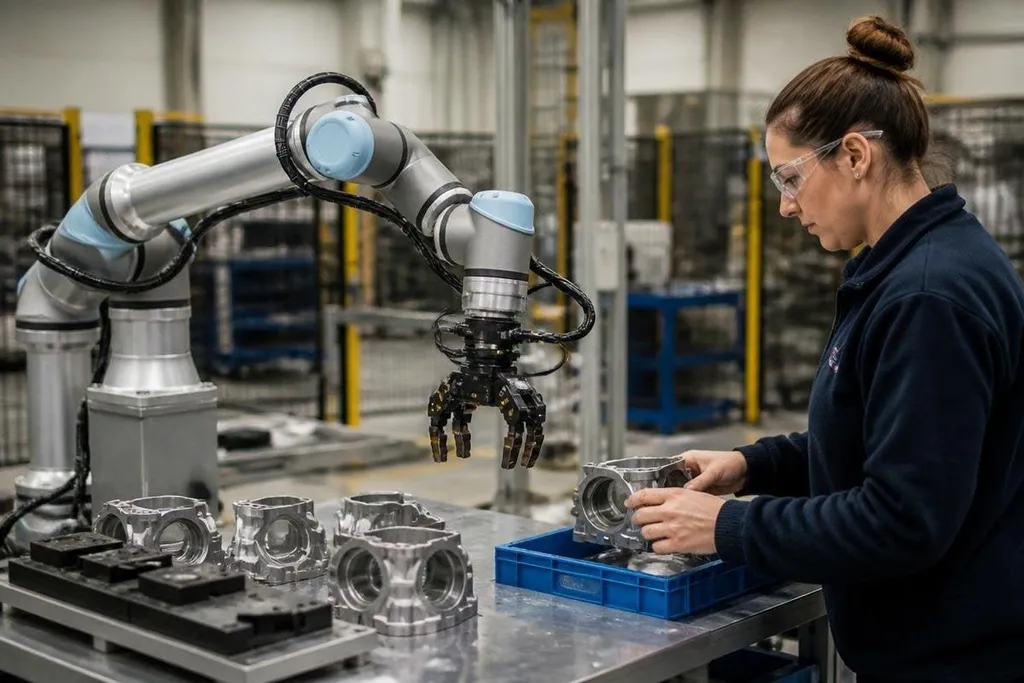
Traditional industrial arms remain a good fit for stable work. A part arrives at the same point, the tool follows the same path, and a safety fence keeps people outside the work area.
That setup works because the factory controls the scene. Fixtures hold parts in place, conveyors set the timing, and the robot repeats a tested motion.
If the product changes often, each change can require new fixtures, new programming, or a new tool. The next step is not one shape of robot. It is a control system that can cope with more variation while keeping the task within known limits.
What changes on the factory floor
Machine vision gives a robot images of its work area. Software then finds the part, estimates its position, and sends a target point to the arm. This helps with bins and trays where parts do not land in one exact spot, but lighting, glare, dust, and blocked views can still cause failures.
Force sensing adds another source of information. A joint sensor or wrist sensor can detect contact while a gripper closes or a tool meets a surface. That matters when the robot must insert a plug, fit a cover, or handle a part that can move under pressure.
The third change is easier task setup. A technician may still need to define the work area, tool, speed, and safe stop points, but the system can use recorded positions and visual checks instead of relying on long blocks of hand-written motion code.
No part of this removes the need for testing. A robot that finds a part correctly can still drop it, damage it, or stop when a person enters the cell.
Software matters as much as the arm
A robot arm is one part of a factory system. The gripper, camera, conveyor, safety scanner, control software, and data link must work together during the same cycle.
That connection is where many claims need a close look. Ask what the robot does when the camera loses the part, the gripper fails to close, or the conveyor stops early. A useful system records the fault, stops in a safe state, and gives a technician enough information to fix the cause.
A factory robot claim means little without the task, test site, date, and result behind it. Robot24.com factory robotics coverage can place those facts beside reports from machine builders and labs, giving you a clear basis for judging what the system can do before changing parts tests its limits.
The unproven part is general-purpose control. A system may handle one family of parts well and fail when shape, surface, weight, or lighting changes. A short demonstration cannot answer that question.
What to check before buying
A plant manager can cut through the sales material by asking for task-level evidence:
- Name the task: What exact part, tool, cycle, and handoff does the robot handle?
- Check the limits: What payload, reach, speed, surface, and lighting conditions apply?
- Ask for failure data: How often does the system stop, mis-pick, drop a part, or need help?
- Review safety: Which sensors stop motion, and how does a technician reset the cell?
- Price the full cell: Include the arm, gripper, camera, fixtures, software, installation, and service.
- Plan the changeover: Find out who updates the robot when the part or process changes.
These questions connect a robot's features to the work you need done. They also show whether the maker has measured the full production cycle or only the successful runs.
The practical test
Start with one task that already has clear quality checks. Record cycle time, missed picks, stops, operator help, and setup time before changing the cell. Then run the new system against the same measures.
A factory robot earns its place when it repeats the required work, reports failures clearly, and can be changed without a long engineering project. Vision, force sensing, and easier programming can help, but the purchase decision still rests on the task record.
I'd skip any system that cannot show how it handles failure, changeover, and service. New factory robots will be judged on those records, not on how smoothly a demo runs.